Ground source heat pump installation
For homes with land, big heat demand and a long view
A ground source heat pump takes heat from pipes buried in your garden or field, or from a borehole, and uses it to run your heating and hot water. The ground stays at a fairly steady temperature all year, which is why these systems work so well in big, rural homes. They cost more to put in than air source, so we'll be straight with you about whether the numbers stack up for your property.
Trenches or a borehole?
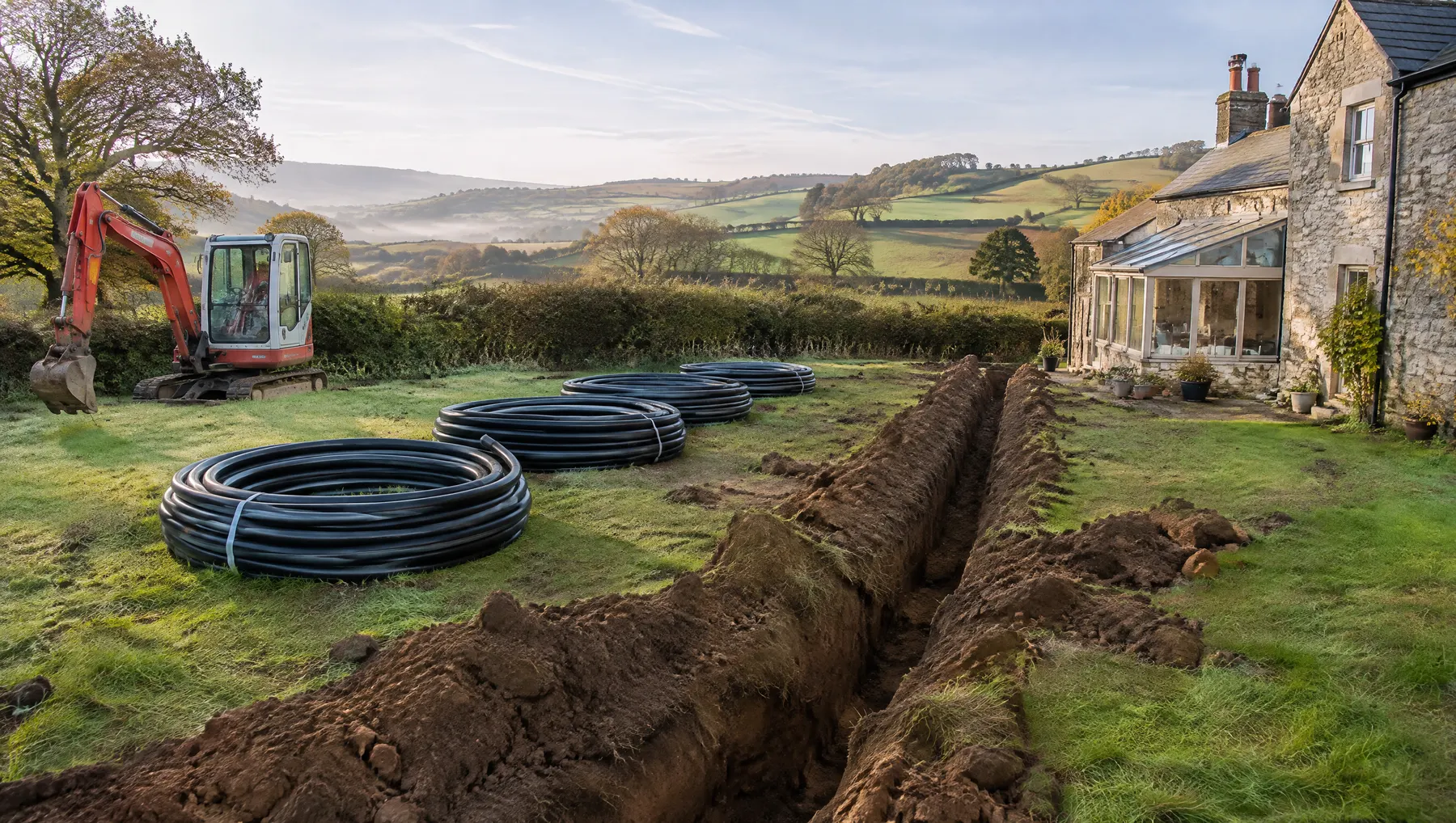
There are two main ways to collect heat from the ground. A horizontal loop is pipe laid in trenches, normally a metre or two down, across a decent area of garden or paddock. It's usually the cheaper option if you have the space and the ground is diggable.
A borehole goes straight down, often a long way, and needs a specialist drilling rig. It takes up almost no surface room, which suits smaller plots or ground that's too rocky to trench. It costs more. On a survey we look at your land, access for machinery and what's underneath before recommending either.
Who it suits
Ground source makes most sense where heat demand is high and there's room to work: farmhouses, barn conversions, large detached homes, and properties currently burning a lot of oil or LPG. It also suits people who don't want an outdoor fan unit on the house, because almost everything sits indoors or underground.
For a typical semi with a small garden, an air source heat pump usually gives better value. We'll tell you if that's the case.
What it costs
The government's Boiler Upgrade Scheme statistics put the median reported cost of a ground source installation at £26,500 in 2025/26, before the grant. That figure comes from costs installers record on MCS certificates, and the range is wide because groundworks vary so much from site to site. It's a national figure, not our price.
The grant for ground source is £7,500, or £9,000 until March 2027 if your home is heated by oil or LPG and has no mains gas. Groundworks needed for a ground source heat pump are also covered by the zero rate of VAT until 31 March 2027. Details on our Boiler Upgrade Scheme page.
Inside the house
Like any heat pump, ground source runs at lower flow temperatures than a boiler. We check every radiator against the heat loss figures, and in barn conversions and extensions underfloor heating is often the best partner. You'll also need a hot water cylinder and a bit of plant room space for the heat pump unit itself, which is roughly the size of a large fridge.
What happens, step by step
Survey
We walk the land, check access for diggers or a drilling rig, and survey the house.
Design and quote
You get a loop or borehole design, the heat pump size and a fixed price with the grant deducted.
Groundworks
Trenches are dug and the loop laid, or the borehole drilled. This is the messy bit, and we plan it around your land.
Plant room and heating
The heat pump, cylinder and controls go in, and any radiators that need upgrading are swapped.
Commissioning
We test, balance and commission the system, then register it with MCS.
What is included
- Site survey covering land, access and ground conditions
- Room-by-room heat loss calculation and system design
- Ground loop or borehole design and groundworks coordination
- Heat pump, cylinder, controls and any radiator upgrades
- Boiler Upgrade Scheme application handled for you
- Commissioning, MCS certificate and controls handover
Ground source heat pumps FAQs
How much land do I need for a horizontal loop?
It depends on the heat demand of the house and the ground itself, so we work it out on survey rather than quoting a rule of thumb. As a rough guide, think paddock rather than patio. If the space isn't there, a borehole is the answer.
Is ground source better than air source?
Not automatically. Ground source is steadier in cold weather and has no outdoor fan unit, but it costs a lot more to install. For a big rural home with land, it can be the better long-term choice. For most smaller homes, air source wins on value.
Will the groundworks wreck my garden?
There will be disruption, no point pretending otherwise. Trenches are backfilled and the ground settles, and grass usually comes back within a season. A borehole leaves a much smaller footprint but needs access for a drilling rig.
Can a ground loop be shared between homes?
Yes. Shared ground loops serving several properties are covered by the Boiler Upgrade Scheme too. They need more planning between neighbours, so talk to us early if that's what you have in mind.
Get a fixed price for your home
Tell us about the job and we will arrange a free survey.