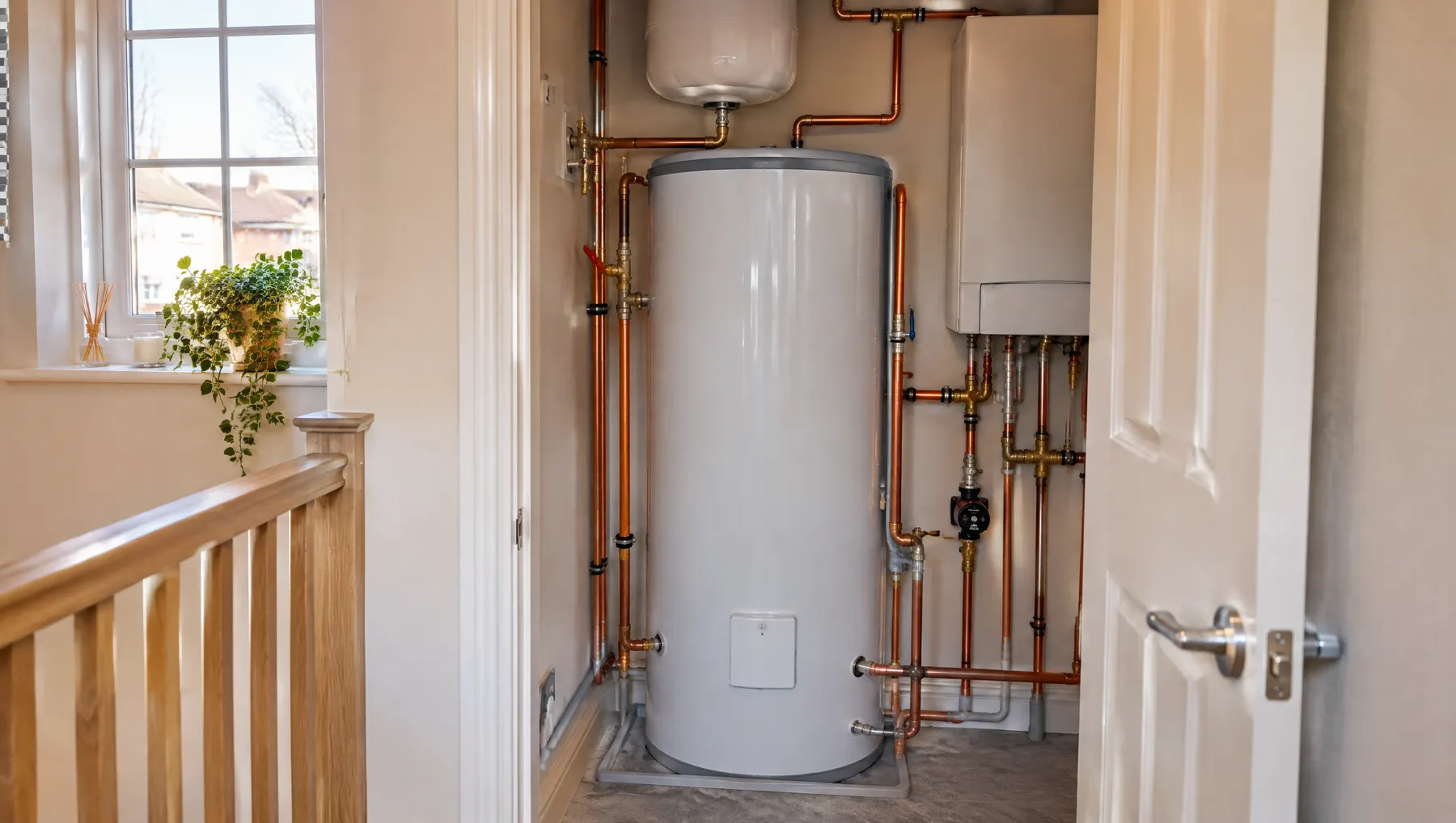
A combi boiler suits most homes with one bathroom, because it heats water straight from the mains with no tanks. A system or regular boiler with a hot water cylinder is the better choice when two or more showers or baths run at the same time, or when a home's pipework and water supply make a combi struggle.
All three types are condensing boilers these days, and all three can run on gas, oil or LPG. The difference is how they deliver hot water, and that is what you are really choosing between.
The three types at a glance
| Combi | System | Regular (heat only) | |
|---|---|---|---|
| Hot water | Heated on demand from the mains | Stored in a cylinder | Stored in a cylinder |
| Hot water cylinder | No | Yes, usually unvented | Yes, usually vented |
| Tanks in the loft | None | None | Cold water tank plus feed and expansion tank |
| Several taps at once | Flow drops when two outlets run | Good, depends on cylinder size | Good, but pressure depends on tank height |
| Space needed | Least: the boiler only | Boiler plus a cylinder cupboard | Boiler, cylinder and loft space |
| Typical home | Flats, terraces, smaller semis with one bathroom | Larger homes with two or more bathrooms and good mains | Older homes with existing tanks, or weak mains pressure |
How a combi boiler works
A combination boiler does two jobs in one box. When you turn on a hot tap, it switches from heating the radiators to heating mains water as it passes through. Worcester Bosch describes it simply: combis heat water directly from the mains when you turn on a tap.
The upside is space and simplicity. No cylinder, no loft tanks, and you never run out of hot water because it is made as you use it. That is why combis are by far the most common type in UK homes.
The catch is flow. A combi can only heat so many litres a minute. Run the kitchen tap while someone is in the shower and both get weaker. In a home with one bathroom that rarely matters. In a family home with an en suite and two teenagers, it matters every morning.
A combi also depends on your mains water. If the incoming pressure and flow are poor (common in some older Devon and Cornish villages at the end of a long supply main), no combi will give a strong shower. We test the mains flow on survey for exactly that reason.
How a system boiler works
A system boiler heats your radiators directly and heats a separate hot water cylinder. The pump and expansion vessel are built into the boiler, so there are no loft tanks. Most new system boilers are paired with an unvented cylinder, which is fed from the mains and stores hot water at mains pressure.
That combination gives strong flow to several outlets at once. Two showers and a bath can run together, limited mainly by the cylinder size and the mains supply. The trade-off is space for the cylinder and some heat loss from storing hot water, although modern cylinders are well insulated.
There is a bonus for the future. A cylinder can take a heat pump or solar thermal later on, which a combi cannot. If you might go renewable in the next ten years, that is worth weighing. Our hot water cylinder page covers vented and unvented options.
How a regular boiler works
A regular boiler (also called heat only, conventional or open vent) is the traditional setup. It needs a cold water storage tank in the loft, a small feed and expansion tank, and a vented hot water cylinder, usually in an airing cupboard. Water pressure comes from gravity, so it depends on how high the tank sits above your taps.
It sounds old-fashioned, and in many ways it is. Still, Worcester Bosch makes a fair point: a regular boiler can be the best replacement where a home already has a traditional system, because older radiators and pipework may not cope with the higher pressure of a sealed system or combi. It is also the fallback where mains pressure is too weak for anything else.
Which one should you choose?
Go combi if
- You have one bathroom, or a bathroom plus a downstairs loo.
- Your mains pressure and flow are decent (we test this).
- You want the cupboard space back, or to clear the loft for a conversion.
- You are replacing an old tank system and want to simplify. That job is called a combi conversion.
Go system if
- You have two or more bathrooms that get used at the same time.
- Mains pressure is good and you want strong showers everywhere.
- You have room for a cylinder, and maybe plan to add a heat pump or solar later.
Stay regular if
- Your mains pressure is low and cannot support a combi or unvented cylinder.
- The existing radiators and pipework are old and you do not want to replace them yet.
- You have a period home with a working gravity system and want the least disruption.
Common mistakes to avoid
The most common one is fitting a big combi to fix a hot water problem. A higher kW rating gives a bit more flow, but it cannot beat the limit of your mains supply. If two showers at once is the goal, a cylinder is usually the honest answer. Our guide to what size boiler you need explains why bigger is not always better.
The second is converting to a combi without checking the radiators and pipework. Moving from an open vented system to a sealed one raises the pressure in the pipes, and weak old joints or radiators can start to weep. A good installer checks this and power flushes or replaces what needs it before the new boiler goes on.
The third is forgetting the cylinder space. Taking the cylinder out is great for storage, but if you later want a heat pump you will need that space again.
What it means for the cost
A like-for-like swap is usually the simplest job. Changing type adds work: a combi conversion means removing tanks and cylinder and reworking pipework, while a system upgrade means fitting an unvented cylinder with its safety discharge pipework. Our new boiler cost guide explains what affects the price, and we give a fixed quote after a survey so there are no surprises.
Frequently asked questions
Is a combi or system boiler better for a three-bedroom house?
It depends on bathrooms and habits more than bedrooms. Three bedrooms with one bathroom usually suits a combi well. Add an en suite that gets used at the same time as the main bathroom and a system boiler with a cylinder starts to make more sense.
Can I switch from a regular boiler to a combi?
Usually, yes. It is called a combi conversion. The loft tanks and hot water cylinder come out and the pipework is reworked. We check your mains pressure first, plus the condition of the radiators, because a sealed system runs at higher pressure than the old one.
Do system boilers need a loft tank?
No. A system boiler has the pump and expansion vessel built in and runs as a sealed system. Paired with an unvented cylinder, there are no tanks in the loft at all.
Which boiler type is most efficient?
On paper, modern combi, system and regular boilers are similarly efficient because they are all condensing. A combi wastes less because it does not store hot water. A system boiler with a well-insulated cylinder runs close, and it can work with a heat pump or solar later.
Will a combi boiler work with low water pressure?
Not well. A combi can only deliver what comes in from the mains. If your flow is weak, showers will be weak too. In that case a regular boiler with gravity-fed tanks, or a system with an accumulator, may be the better route. A survey settles it.