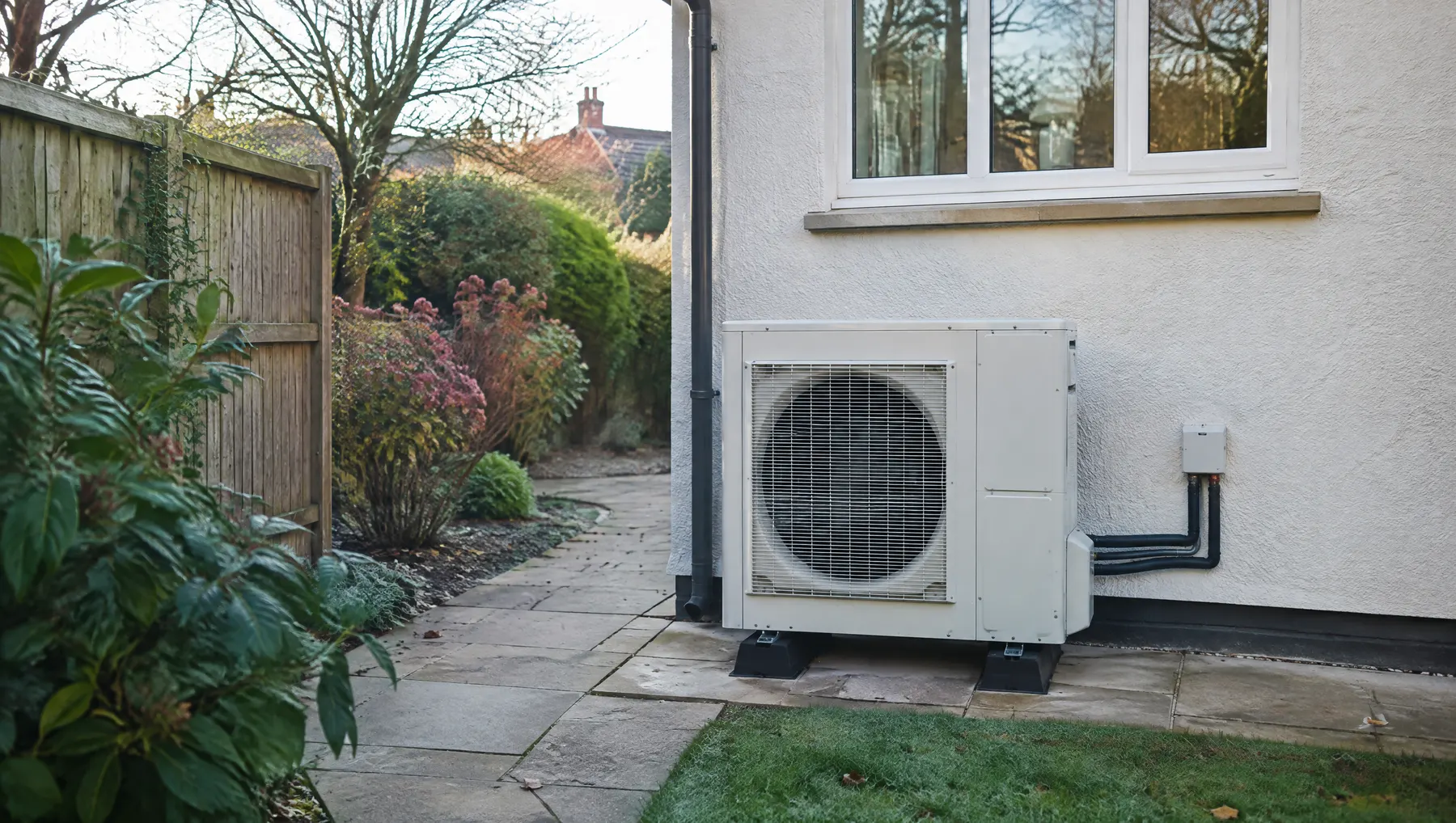
In England, you usually do not need planning permission for an air source heat pump on a house, because it counts as permitted development as long as it meets a set of conditions. You will need to apply if your home is listed, if the unit breaks the size, number or siting limits, or if your council has removed permitted development rights in your area.
The rules were relaxed in May 2025, so older advice you find online (especially anything mentioning a one metre gap from the boundary) may be out of date. Everything below is based on the Planning Portal's current guidance and the 2025 amendment order. It covers England only; Wales, Scotland and Northern Ireland have their own rules.
Air source heat pumps: the permitted development conditions
For a house in England, an air source heat pump is permitted development if it meets all of these, according to the Planning Portal:
| Condition | The rule for houses |
|---|---|
| Certification and noise | The installation must comply with the MCS 020a planning standards |
| Size | The outdoor unit, including its housing, must be no more than 1.5 cubic metres |
| Number of units | Detached house: the first two units. Other houses: the first one only |
| Pitched roof | Not permitted development |
| Flat roof | Every part of the unit at least one metre from the external edge of the roof |
| Walls facing a highway (most areas) | Not fixed to a wall fronting a highway above ground-floor level |
| Use | Must not be used solely for cooling |
| Siting | Placed, as far as practicable, to minimise its effect on the look of the building and the amenity of the area |
| When no longer needed | Removed as soon as reasonably practicable |
Blocks of flats have tighter limits: a 0.6 cubic metre maximum and only the first unit counts as permitted development.
What changed in 2025
The Town and Country Planning (General Permitted Development) (England) (Amendment) Order 2025 (S.I. 2025/560) came into force on 29 May 2025. The headline changes were removing the old rule that units had to sit at least one metre from the property boundary, raising the size limit for houses to 1.5 cubic metres, and allowing two units on detached houses. The Planning Portal also confirms that from 28 May 2026, MCS 020a became the only permitted certification standard for the noise and siting assessment.
Listed buildings
This is the big one in the South West, with its listed farmhouses, Georgian townhouses in Bath and old fishing cottages along the coast. Permitted development rights for heat pumps do not apply within the curtilage of a listed building, or on a Scheduled Monument site. Curtilage means the land and outbuildings that go with the house, so putting the unit at the bottom of the garden does not get you round it.
You will need planning permission, and you may also need listed building consent. Under section 7 of the Planning (Listed Buildings and Conservation Areas) Act 1990, works that alter a listed building in a way that affects its character need consent. Drilling through historic walls for pipework, fixing brackets to the building or running cables can all count. Doing that work without consent is a criminal offence, as councils like Bath and North East Somerset point out.
Talk to your council's conservation officer early. Many councils offer pre-application advice, and a conservation officer will often have a view on where a unit would be acceptable.
Conservation areas and World Heritage Sites
Heat pumps are still permitted development in a conservation area or World Heritage Site, but with two extra conditions on top of the standard list:
- The unit must not be fixed to a wall or roof that fronts a highway.
- It must not be nearer to any highway bounding the property than any part of the house.
In practice that usually means a rear or side elevation that cannot be seen from the road. That matters across the region: the whole of Bath is a World Heritage Site, and conservation areas cover the old centres of towns such as Totnes, Dartmouth, Wells and St Ives, plus many villages.
Article 4 directions
Some councils use Article 4 directions to remove permitted development rights in particular streets or areas, and rights can also be removed by a condition on an earlier planning permission. If either applies to your home, you need to apply even if the unit meets every condition above. Your council can tell you.
National parks
If you live in Dartmoor or Exmoor National Park, the national park authority is your planning authority rather than the district council. Check with them before you commit, especially in a conservation area or on a listed building, which are common in moorland villages.
Ground source heat pumps
The Planning Portal says installing a ground source or water source heat pump on a house is usually permitted development, with the same advice to check with the council for listed buildings and conservation areas. Since 1 October 2023, some new ground source systems may also need an Environment Agency permit, with exemptions set out on GOV.UK. Your installer should check this before drilling or digging.
Building regulations still apply
Planning and building regulations are separate. A heat pump installation still needs to meet building regulations for things like electrical work and hot water storage. An MCS certified installer will handle the paperwork and register the installation, which you also need for the Boiler Upgrade Scheme grant. Our Boiler Upgrade Scheme page explains how that works.
How we handle it
When we survey for an air source heat pump, siting and planning are part of the job. We check whether the house is listed or in a conservation area, run the MCS 020a noise assessment, and tell you plainly whether permitted development applies or you need to apply. If you are weighing a heat pump against a new oil boiler, our oil boiler vs heat pump guide may help, and for costs see our air source heat pump cost page.
Frequently asked questions
Do I need planning permission for an air source heat pump in England?
Usually not. It is permitted development on a house if it meets the conditions: MCS 020a compliance, an outdoor unit no bigger than 1.5 cubic metres, not on a pitched roof, and limits on numbers and siting. Listed buildings always need an application.
Is the one metre boundary rule still in force?
No, not in England. The 2025 amendment order removed it. The noise assessment under MCS 020a still applies, so a unit right on the boundary still has to pass that.
Can I put a heat pump on a listed building?
Possibly, but not under permitted development. You need planning permission and very likely listed building consent too. Speak to the council's conservation officer before you commit to a design.
Can I have a heat pump at the front of my house in a conservation area?
Not under permitted development if it is on a wall facing the road, or closer to the road than the house. A rear or side position usually works. If the front is the only option, you would need to apply.
How many heat pumps can I install without planning permission?
On a detached house, the first two. On a semi, terrace or other house, just the first one. Any more need a planning application.
Does the planning rule apply in Wales?
This guide covers England only. Wales has its own permitted development rules, so check with your local council or the Planning Portal's Welsh guidance.
- Planning Portal: Air source heat pump planning permission
- Planning Portal: Ground source or water source heat pump
- legislation.gov.uk: The Town and Country Planning (General Permitted Development) (England) (Amendment) Order 2025
- legislation.gov.uk: Planning (Listed Buildings and Conservation Areas) Act 1990, section 7