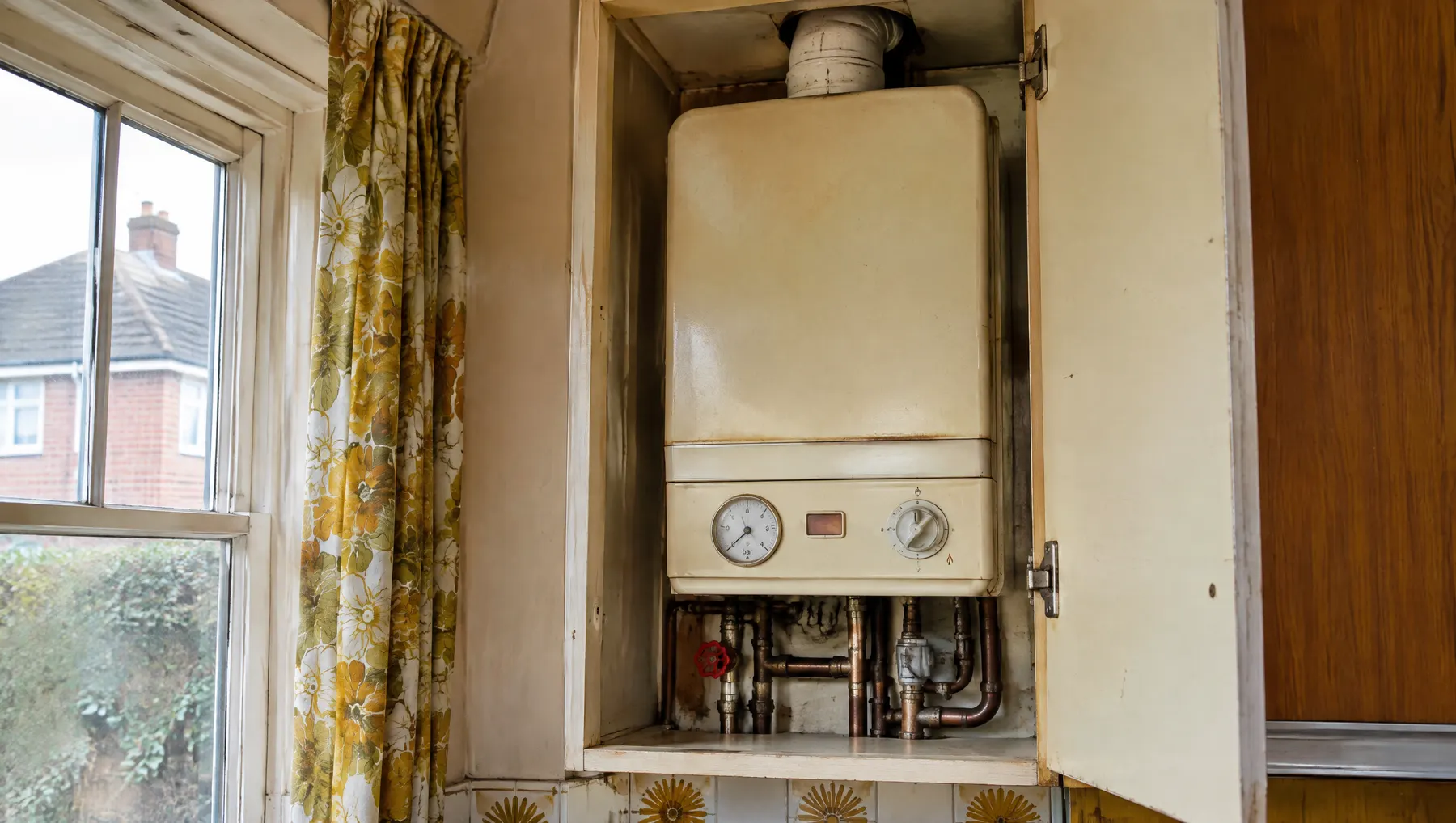
A good-quality gas, oil or LPG boiler that is serviced every year will usually last between 10 and 15 years. Some keep going for 20 years or more, but past the 15-year mark you tend to pay for it in repairs, falling efficiency and parts that are harder to find.
That 10 to 15 year figure is the one the big manufacturers give themselves. Worcester Bosch, Vaillant and Ideal all put a well-looked-after boiler in roughly that bracket (links in the sources below). What they agree on is that the number on the box matters less than how the boiler is treated once it is on the wall.
What decides how long your boiler lasts
Worcester Bosch makes a point worth repeating: boiler type (combi, system or regular) and fuel (gas, oil or LPG) have no real connection to lifespan. Three things do.
1. Build quality
Better heat exchangers, sturdier pumps and fans, and good parts support all add years. A budget boiler can run perfectly well, but it usually has less margin when the system around it is not in great shape.
2. The water inside your system
This is the one most people never think about. Radiators and pipes slowly corrode, and the debris (black sludge, mostly iron oxide) travels round the system until it settles in the boiler's heat exchanger. Vaillant puts it bluntly: sludge build-up can drastically shorten a boiler's life.
The fixes are cheap compared with a new boiler: a dose of inhibitor in the system water, a magnetic filter on the return pipe to catch debris, and a flush when the water is already badly contaminated.
3. Servicing
An annual service catches worn seals, failing sensors and poor combustion before they turn into a breakdown in January. It also keeps your manufacturer guarantee valid, because most guarantees ask for a yearly service by a registered engineer. Our guide to how often a boiler should be serviced covers what that visit involves.
Local factors in the South West
Two things specific to this part of the country can chip away at a boiler's life.
- Salt air. Flue terminals and outdoor pipework on seafront homes along the Dorset, Devon and Cornish coasts take a beating. It does not usually kill the boiler itself, but corroded flues and condensate pipes cause faults and failed safety checks.
- Hard water. Much of Somerset and Dorset sits on chalk and limestone, so the water is hard. Limescale builds up in the hot water side of a combi and slows it down. Granite areas of Devon and Cornwall tend to have softer water, so it is less of an issue there.
- Frozen condensate pipes. Modern condensing boilers drain water through a small plastic pipe, often run outside. In an exposed spot on Dartmoor or Exmoor a cold snap can freeze it and lock the boiler out. Proper sizing and insulation of that pipe prevents most of these call-outs.
Typical life by boiler age and condition
| Boiler age | What to expect | What we would suggest |
|---|---|---|
| 0 to 5 years | Should be reliable and within its guarantee period | Service every year and register the guarantee if it has not been done |
| 5 to 10 years | Normal wear, the odd part (fan, diverter valve, sensor) may go | Repair is usually worth it. Check the system water is clean |
| 10 to 15 years | Out of guarantee, more frequent faults, efficiency drifting | Weigh each repair against the cost of replacing. Get a quote so you know |
| 15 years plus | Parts can be discontinued, bills creep up | Plan a replacement on your terms rather than waiting for a winter breakdown |
Signs your boiler is near the end
Age alone is not a reason to rip a boiler out. These are the signs that tell you it is genuinely on borrowed time.
- Repairs are getting more frequent, and each one seems to lead to the next.
- Your engineer struggles to get parts, or says the model is discontinued.
- Gas or oil bills are rising when your usage has not changed.
- It is getting noisier: banging, gurgling or a kettle-like rumble (often scale or sludge in the heat exchanger).
- It keeps losing pressure, or radiators take an age to warm up.
- It is an old non-condensing model. Ideal points out these are significantly less efficient than modern condensing boilers.
One sign is not about lifespan at all. If the flame is yellow or orange rather than crisp blue, or you see soot or brown staining around the case, stop using the boiler and get it checked. Those are warning signs of poor combustion and possible carbon monoxide. Our guide on what to do if you smell gas covers the safety steps.
Repair or replace?
There is no single cut-off, but a simple way to think about it: if the boiler is past 10 years, the repair is a major part, and it is the second or third significant fault in a couple of years, replacement usually makes more sense. You get a new guarantee, better efficiency and modern controls, and you stop spending money on a boiler with a limited future.
If the boiler is younger and the fault is a one-off, repair it. A good engineer will tell you honestly which side of the line you are on. For a sudden failure, see our emergency boiler repair page. If you are leaning towards replacing, our guide to what a new boiler costs explains what goes into the price.
How to make your next boiler last longer
- Get the system cleaned before the new boiler goes in. Fitting a new boiler to dirty water is the fastest way to shorten its life.
- Have a magnetic filter and inhibitor fitted at installation. Several manufacturers make a filter a condition of their longer guarantees.
- Register the guarantee with the manufacturer straight away.
- Book a service every year, ideally before the heating season starts.
- In a hard water area, ask about a scale reducer on the mains feed to a combi.
- Keep an eye on the pressure gauge. Regular top-ups mean a leak somewhere that needs finding.
What about heat pumps?
If your boiler is near the end and you are off the gas grid, it is worth looking at a heat pump before you replace like for like. The government's Boiler Upgrade Scheme currently gives £7,500 towards an air source or ground source heat pump in England and Wales, and the GOV.UK page shows an extra £1,500 until March 2027 for homes heated by oil or LPG with no mains gas connection. Our oil boiler vs heat pump guide runs through the trade-offs.
Frequently asked questions
What is the average lifespan of a boiler in the UK?
Between 10 and 15 years for a quality boiler that is serviced every year. That is the range Worcester Bosch, Vaillant and Ideal all give. Some run past 20 years, but by then repairs tend to get more frequent and parts harder to find.
Do combi boilers last as long as system boilers?
Yes. Worcester Bosch says boiler type and fuel have no real link to lifespan. What matters is build quality, clean system water and annual servicing. A combi in a hard water area does need more attention on the hot water side because of limescale.
Is it worth repairing a 15-year-old boiler?
Sometimes, for a small part. For a major repair it usually is not. At that age the boiler is out of guarantee, parts may be discontinued and efficiency has dropped, so you can end up paying for one repair after another. Get a replacement quote alongside the repair price and compare.
Does servicing really make a boiler last longer?
It does, because the engineer spots wear and combustion problems early. Servicing also keeps most manufacturer guarantees valid. Skip it for a few years and a small, cheap fix can become a failed heat exchanger.
Do oil boilers last as long as gas boilers?
Generally, yes. Worcester Bosch states that fuel type does not decide lifespan. An oil boiler that is serviced yearly by an OFTEC registered technician, with a clean tank and filter, should give a similar span to a gas one.