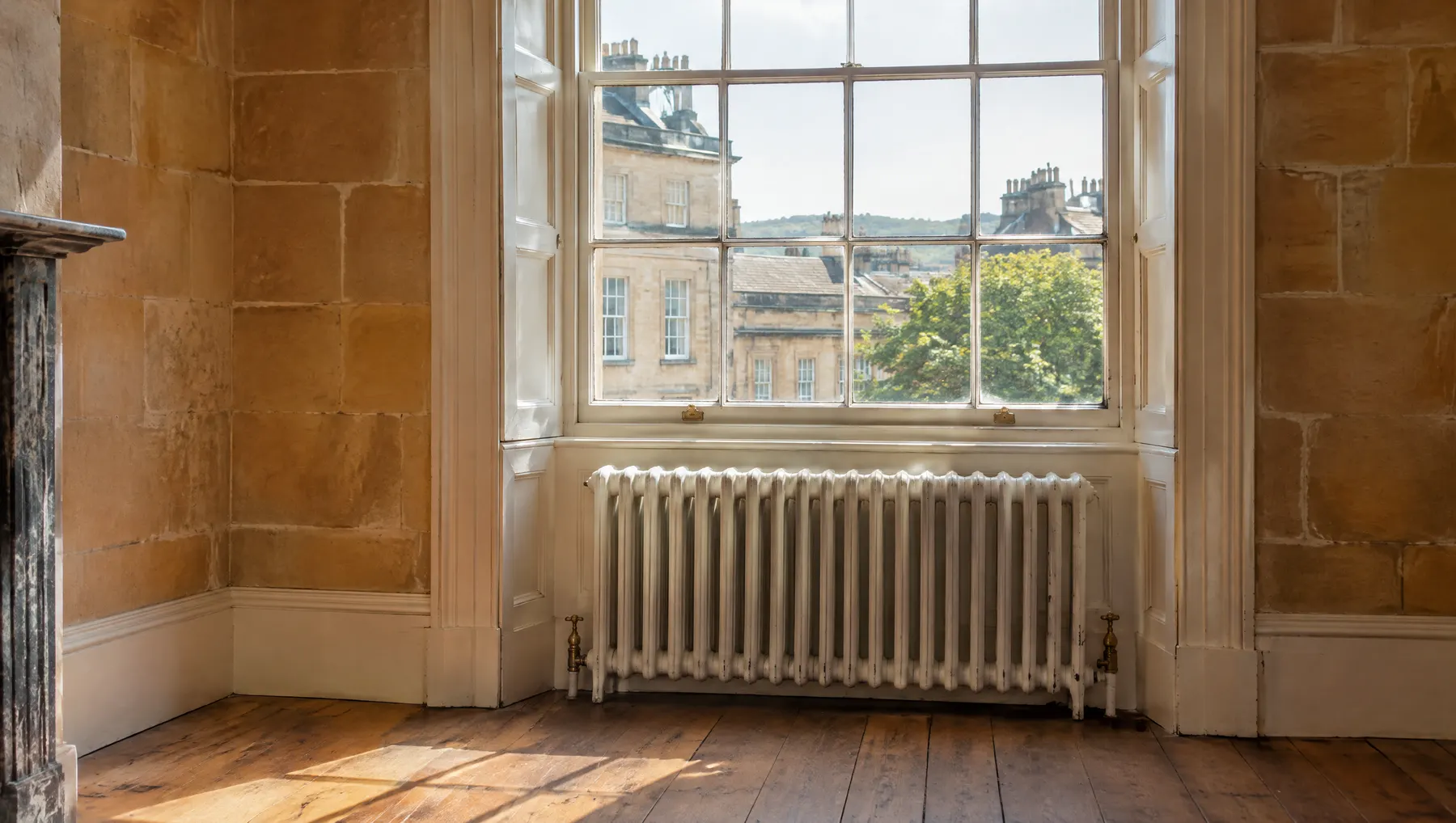
A period home heats best with steady, gentle warmth from a well-sized system, routed so it does not damage historic fabric. If the building is listed, you will usually need listed building consent for anything that alters its character, which can include new flue openings, external pipework and heat pump units, so speak to the council's conservation officer before you commit.
That applies whether you own a Georgian terrace in Bath, a cob longhouse in mid Devon or a granite cottage near St Just. The details differ by building, so here is how to think it through.
Know your walls
Traditional South West buildings were built with solid walls that handle moisture very differently from a modern cavity wall. Understanding that is the starting point for any heating plan.
| Wall type | Where you find it | What it means for heating |
|---|---|---|
| Bath stone (oolitic limestone) | Bath, and villages around it in north east Somerset | Soft, porous stone that needs to breathe. Lime mortars and renders matter. Avoid fixings and flue holes in ashlar fronts where you can |
| Cob (earth, straw and water) | Mid and east Devon, parts of west Dorset and Cornwall | Thick walls that hold heat but must stay dry. Never seal with cement or plastic paints. Keep pipe runs and condensate drains well away from the wall base |
| Granite | Cornwall, Dartmoor and the Isles of Scilly | Hard, dense and often cold to the touch. Thick walls with little insulation, and many cottages were built with small windows and low ceilings |
| Other local stone and brick | Purbeck, Ham stone around Yeovil, Mendip limestone, Victorian brick in the towns | Solid walls, usually higher heat loss than modern homes, and plenty of character worth protecting |
Solid-wall homes generally lose heat faster than modern ones, and they behave better with steady background warmth than with blasts of heat morning and evening. Rapid temperature swings can draw moisture through old walls and cause condensation in cold corners.
Listed building consent: when you need it
Under section 7 of the Planning (Listed Buildings and Conservation Areas) Act 1990, nobody may carry out works to alter or extend a listed building in a way that affects its character without consent. This applies to the inside as well as the outside, and to every grade of listing.
Bath and North East Somerset Council puts it plainly: unauthorised work is a criminal offence, owners can be prosecuted, and selling a property can be difficult without consent for past work. Listed building consent is also separate from planning permission, so you may need both.
Heating work that often needs consent
- Cutting a new flue opening through a historic wall or roof.
- Fitting a flue terminal, external pipework or a condensate pipe on a visible elevation.
- Lifting historic floors, notching joists or chasing walls for pipework.
- Removing or altering original fireplaces, chimney breasts or historic radiators.
- Fixing a heat pump unit or brackets to the building.
Like-for-like replacement of a boiler in the same position, using the existing flue route, is often less of an issue. Even so, the decision sits with the council, not the installer. If in doubt, ask the conservation officer first. Many councils offer pre-application advice.
Flues: the part that causes most trouble
Modern condensing boilers need a balanced flue that takes air in and pushes fumes out, and they produce a visible plume of water vapour. On a listed Bath townhouse, a new white flue terminal and plume on the front elevation is unlikely to be welcome. Some options worth discussing:
- Using an existing flue route where it is safe and suitable.
- Putting the boiler on a rear or side wall, or in the roof space with a vertical flue, to keep the front clear. Our boiler relocation page covers moving a boiler.
- Using an approved flue liner kit up a redundant chimney, where the manufacturer allows it.
- Choosing terminal positions and plume kits that keep the visible part discreet.
Any flue still has to meet the boiler manufacturer's instructions and the clearances in the Building Regulations, so safety sets the limits and the conservation officer decides what is acceptable within them.
Replacing an old back boiler
Plenty of period homes still have a back boiler behind a gas fire in the living room, often in an original fireplace. Replacing one means taking out the fire, capping or reusing the chimney, and moving the new boiler elsewhere. In a listed building the fireplace itself may be protected. Our back boiler replacement page explains the job.
Conservation areas and World Heritage Sites
Many South West towns and villages have conservation areas, and the City of Bath is a World Heritage Site. Being in one does not stop you upgrading your heating, but it adds rules on what can be seen from the street.
For heat pumps, the Planning Portal says that in conservation areas and World Heritage Sites the unit must not be fixed to a wall or roof that fronts a highway, and must not be nearer to the highway than any part of the house. Councils can also remove permitted development rights through Article 4 directions. Check with your council before fitting anything on a front elevation.
Heat pumps in period homes
A heat pump can work in an old building, and the steady low-temperature heat suits solid walls well. The challenges are heat loss and siting. Larger radiators or underfloor heating may be needed to deliver enough warmth at low flow temperatures, and the outdoor unit needs a position that is acceptable on a listed or conservation area property.
Note that permitted development rights for air source heat pumps do not apply within the curtilage of a listed building, according to the Planning Portal. Our guide to heat pump planning permission explains the rules in full.
Radiators, pipework and floors
- Radiators. Cast iron column radiators suit many period rooms and give steady radiant heat. Sizing them properly for the room's heat loss matters more than the style. Our radiator installation page covers upgrades.
- Pipework. Route new pipes along existing runs where possible, under floors that are already lifted, or in discreet surface-mounted copper. Avoid notching historic joists.
- Underfloor heating. It can work well under new or relaid stone floors, but laying it may mean disturbing historic floors and changing how moisture moves through the ground. Take advice first, particularly with cob and earth floors.
- Controls. Smart thermostats and room-by-room zoning help keep steady temperatures without overheating, which suits old buildings.
Getting it right
- Check the listing status and any conservation area on your council's website.
- Get a survey from an installer who will look at the building, not just the boiler.
- Agree the boiler or heat pump position and flue route with safety and appearance in mind.
- Talk to the conservation officer and apply for consent where needed, before work starts.
- Keep copies of consents and certificates with the house deeds.
Frequently asked questions
Do I need listed building consent to replace a boiler?
Not always. A like-for-like swap in the same place, using the same flue route, may not affect the building's character. A new flue opening, external pipework or a moved boiler often will. The council decides, so check with the conservation officer before work starts.
Can I put a flue on the front of a listed house?
It is unlikely to be approved on a principal elevation, and you would need consent either way. Rear or side walls, vertical flues through the roof, or an approved liner up an existing chimney are usually easier routes.
Is underfloor heating suitable for a cob house?
It can be, but take care. Cob needs to stay dry, and changing how a floor is built can affect moisture in the walls. Get advice from someone who knows earth buildings, and from the conservation officer if the house is listed.
What happens if work is done without listed building consent?
It is a criminal offence. Bath and North East Somerset Council warns that owners can be prosecuted and may struggle to sell without consent for past work. The council can also require the work to be reversed.
Can I have a heat pump in a conservation area?
Yes, often under permitted development, as long as the unit is not on a wall or roof facing the road and is not closer to the road than the house. Listed buildings are different and always need an application.