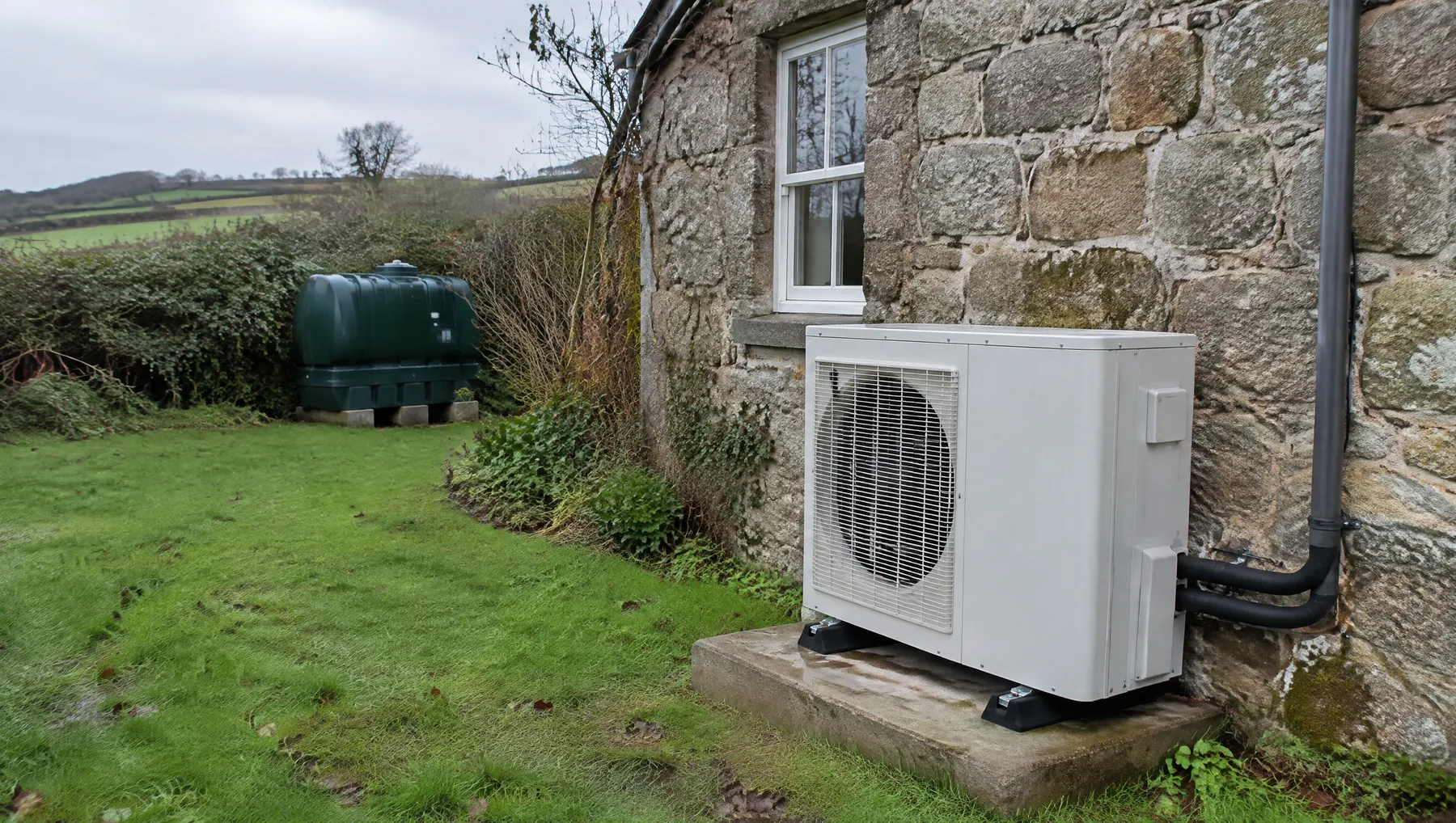
A heat pump is the better long-term choice for most off-grid homes that are reasonably insulated or can be, especially with the Boiler Upgrade Scheme grant of £7,500 plus an extra £1,500 for oil-heated homes until March 2027. A new oil boiler still makes sense where the house loses heat fast and cannot easily be improved, where the budget is tight, or as part of a hybrid system.
Neither answer is right for every home. Across rural Cornwall, Devon, Somerset and Dorset, the housing ranges from draughty granite cottages to well-insulated barn conversions, and that difference decides more than anything else.
The quick comparison
| New oil boiler | Air source heat pump | |
|---|---|---|
| Upfront cost | Lower | Higher, but reduced by the Boiler Upgrade Scheme grant |
| Government grant | None | £7,500, plus £1,500 for oil or LPG homes with no mains gas until March 2027 (GOV.UK) |
| Fuel | Heating oil, delivered by tanker and stored in a tank | Electricity |
| Flow temperature | High, works with existing radiators | Lower, may need some larger radiators |
| Outdoor kit | Oil tank | Outdoor unit, roughly the size of a large suitcase or bigger |
| Hot water | Combi or cylinder | Cylinder needed |
| Carbon emissions | Fossil fuel | Much lower, falling further as the grid decarbonises |
| Installer registration | OFTEC | MCS (required for the grant) |
The grant changes the maths
The Boiler Upgrade Scheme, run by Ofgem for the government, currently pays £7,500 towards an air source or ground source heat pump in England and Wales. GOV.UK also lists an additional £1,500 until March 2027 if your property is heated by oil or LPG and has no mains gas connection. For a typical off-grid home, that is £9,000 off the installed price.
You need to own the property, be replacing a fossil fuel system, and use an MCS certified installer, who applies for the grant on your behalf. GOV.UK says the heat pump must be installed and commissioned within 120 days of the application. Our Boiler Upgrade Scheme page explains how we handle that.
There is no grant for a new oil boiler. If yours is close to the end and you have been on the fence, the March 2027 deadline for the extra £1,500 is worth keeping in mind.
Running costs: be careful with the headlines
This is where most comparisons get slippery. Running costs depend on the price of heating oil and electricity (both swing), how efficient each system is in your house, and your tariff.
OFTEC, the oil heating trade body, says modern oil condensing boilers are over 90% efficient and that heat pumps may be no cheaper to run than an oil boiler. It is worth knowing who is saying it, but the point stands: a heat pump in a leaky house, running at high flow temperatures to keep up, can cost as much or more to run than oil.
Flip it round and a heat pump in a home with decent insulation, sized properly and running at low flow temperatures, produces several units of heat for each unit of electricity. Pair it with a heat pump tariff or solar panels and the numbers improve again. The difference between those two outcomes is mostly design and the house, not the technology.
Rural South West homes: what actually matters
Solid walls and heat loss
Granite in Cornwall and on Dartmoor, cob in mid and east Devon, stone in the Mendips and Purbeck: lots of rural homes here have solid walls with no cavity to fill. They lose heat faster than modern houses. That does not rule out a heat pump, but it means the heat loss survey matters more, and some radiators may need to be bigger.
Some quick wins help either system: loft insulation, draught-proofing, and fixing that one north-facing room that never warms. For listed or traditional buildings, take advice first. Our guide on heating a listed or period home covers that.
Exposure and weather
Hilltop farmhouses on Exmoor and Bodmin Moor get wind and driving rain. Heat pumps work in cold weather, but the outdoor unit needs a sensible spot: sheltered from the worst wind, with room for air to flow and for defrost water to drain away without icing a path.
Oil deliveries and tanks
Anyone who has waited on a tanker down a single-track lane in January knows the downside of oil. You also have a tank to maintain, and older single-skin tanks may need replacing. If you stay on oil, our oil tank installation page covers bunded tanks and siting.
Planning
In England, an air source heat pump on a house is usually permitted development, provided it meets the conditions. Listed buildings are the big exception: permitted development rights do not apply within the curtilage of a listed building. Conservation areas add rules about walls facing a road. See our guide to heat pump planning permission for the detail.
When a new oil boiler still makes sense
- The house has very high heat loss that cannot reasonably be reduced, and radiators cannot be upgraded.
- You need a replacement now, in mid-winter, and cannot wait for a survey and design.
- Budget rules out the higher upfront cost even with the grant.
- You plan to sell soon and want a straightforward like-for-like swap.
If that is you, a modern condensing oil boiler from an OFTEC registered installer is a solid choice. Our oil boiler installation team can quote for that.
The middle ground: hybrid systems
A hybrid pairs a heat pump with a boiler. The heat pump does most of the work through the year, and the boiler steps in on the coldest days or for hot water peaks. For a big, hard-to-heat farmhouse it can be a sensible bridge. Grant rules for hybrids differ, so check eligibility before you commit. Our hybrid heat pump page explains the options.
How to decide
- Get a proper heat loss survey of the house.
- Look at what insulation or radiator upgrades would bring the flow temperature down.
- Get a heat pump design and an oil quote from installers who survey first.
- Factor in the grant, the deadline for the extra £1,500, and your likely years in the house.
- Choose with real numbers in front of you, not a sales pitch.
Frequently asked questions
Do heat pumps work in old stone cottages?
They can, but the design has to be right. Solid granite, cob or stone walls lose heat faster than modern cavity walls, so the survey, radiator sizing and any insulation upgrades matter more. In some very leaky homes a hybrid system or a new oil boiler is the more honest answer.
How much is the Boiler Upgrade Scheme grant for oil-heated homes?
£7,500 for an air source or ground source heat pump, plus an extra £1,500 until March 2027 if the property is heated by oil or LPG and has no mains gas connection, according to GOV.UK. Your MCS certified installer applies for it and takes it off the price.
Is a heat pump cheaper to run than oil?
It can be, but not automatically. A well-designed heat pump running at low flow temperatures in a reasonably insulated home usually compares well. A poorly designed one in a leaky house may not. Fuel and electricity prices also move, so be wary of anyone promising fixed savings.
Can I keep my oil tank if I get a heat pump?
If you go fully electric, the old tank should be emptied and taken away safely once it is no longer needed. If you choose a hybrid, the tank stays to feed the boiler.
Do I need planning permission for a heat pump on a farmhouse?
Usually not, as long as the installation meets permitted development conditions. If the farmhouse is listed, permitted development does not apply and you will need to speak to the council. Check our planning permission guide for the details.