For most off-grid homes, oil is the more common and usually cheaper fuel, and you own the tank so you can buy from any supplier. LPG suits homes where an oil tank is hard to site, where you want gas for cooking too, or where a smaller, cleaner installation matters, but you typically rent the tank and buy from one supplier on a contract.
Both are fossil fuels, and both qualify you for the extra Boiler Upgrade Scheme money if you switch to a heat pump. So before choosing between them, it is worth asking whether a heat pump suits your home. We cover that at the end.
Side by side
| Heating oil (kerosene) | LPG | |
|---|---|---|
| How you buy it | From any supplier, order by delivery | Usually from the company that owns the tank, on a contract |
| Tank ownership | Normally yours | Normally rented from the supplier, with an annual charge |
| Fuel price | Tends to be lower, but can swing sharply | OFTEC calls it one of the most expensive heating fuels |
| Boiler | Oil boiler, combi or system | Gas boiler set up for LPG |
| Cooking | Range cookers like Aga or Rayburn can run on oil | Gas hob and oven from the same supply |
| Tank siting | Above ground, with siting rules | Above ground or buried; supplier sets the rules |
| Registered engineer | OFTEC | Gas Safe, with LPG competence |
| Upgrade Scheme top-up | Extra £1,500 until March 2027 | Extra £1,500 until March 2027 |
Heating oil: the off-grid default
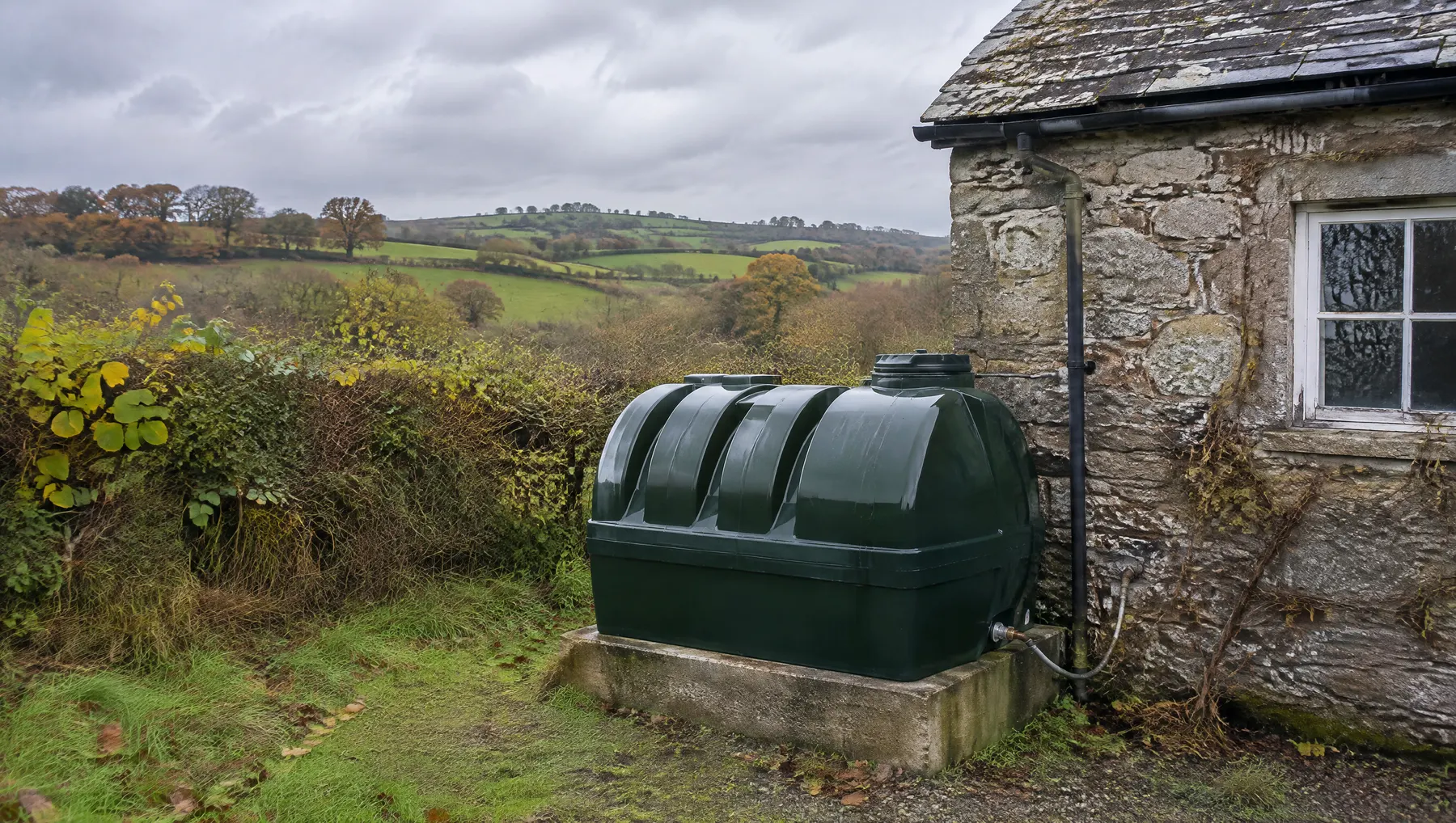
OFTEC, the oil heating trade body, says oil is the fuel of choice for around one million homes in Great Britain. In rural Devon, Cornwall, Somerset and Dorset you will see a green plastic tank behind a lot of cottages and farmhouses.
The big advantage is control. You own the tank, so you can ring round suppliers, join a local oil-buying group, and fill up when prices dip. OFTEC also says modern condensing oil boilers are over 90% efficient, putting them on a par with gas.
The downsides are the tank and the deliveries. A tank needs a suitable spot, a tanker needs to reach it, and oil prices can jump without much warning. Heating oil theft is also a real problem in rural areas, so a lockable tank and a remote level monitor are worth having.
Oil tank rules
GOV.UK guidance says a home oil tank of 3,501 litres or more must have secondary containment, and a bund must hold 110% of the tank's capacity. Smaller domestic tanks are covered by Building Regulations, which deal with things like position and fire protection. An OFTEC registered installer can self-certify that the installation meets the regulations without a separate building control notice. For most homes, a bunded tank is the sensible choice anyway. Our oil tank installation page explains siting.
LPG: flexible but usually dearer
LPG (liquefied petroleum gas, usually propane for home heating) is stored as a liquid under pressure in a tank or bottles. It runs a gas boiler set up for LPG, plus a gas hob, oven or fire from the same supply.
Its strengths are flexibility and cleanliness. The tank can sometimes be buried, which suits a pretty garden or a tight plot. There is no oil smell and no risk of an oil spill. A wall-hung gas boiler is usually more compact than an oil boiler, and you can cook on gas.
The catch is how you buy it. OFTEC points out that LPG tanks are usually supplied by the gas company, an annual rental charge applies, and customers are often tied into long contracts. As an oil trade body, OFTEC has an interest here, but the basic point is fair: you usually cannot shop around for each fill the way you can with oil. Read the contract terms carefully, including how and when you can switch supplier.
For more on how we fit and service these systems, see our LPG boiler page.
Safety and servicing
Both need a yearly service. Oil boilers should be serviced by an OFTEC registered technician, who will also check the tank, filter and supply line. LPG boilers must be worked on by a Gas Safe registered engineer who holds the LPG qualification, so check the back of their Gas Safe ID card.
LPG is heavier than air, so leaks collect at low level rather than drifting away. Oil does not carry the same explosion risk, but a leaking tank can contaminate soil and water, and the clean-up is expensive. Either way, a carbon monoxide alarm is a must in the room with the boiler. Our guide to what to do if you smell gas covers LPG leaks.
Which suits your home?
Oil tends to suit you if
- You have room for a tank that a tanker can reach.
- You want to shop around and control when you buy.
- You already have an oil-fired range cooker.
LPG tends to suit you if
- There is nowhere sensible to put an oil tank, or you would prefer it buried.
- You want gas for cooking.
- You are in a holiday let or small cottage where a compact gas boiler fits better.
Or skip both: the heat pump question
If your boiler is due for replacement, it is worth pricing a heat pump before committing to either fuel. GOV.UK lists the Boiler Upgrade Scheme at £7,500 for an air source or ground source heat pump, plus an extra £1,500 until March 2027 if your home is heated by oil or LPG and has no mains gas connection.
Heat pumps are not right for every off-grid home. Very leaky solid-wall cottages can struggle, and a hybrid might suit better. Our oil boiler vs heat pump guide goes through that, and our Boiler Upgrade Scheme page explains the grant.
Frequently asked questions
Is LPG or oil cheaper to heat a house?
Oil has usually been the cheaper fuel, and OFTEC describes LPG as one of the most expensive heating fuels. Prices for both move, though, and your contract terms make a big difference with LPG. Compare current quotes from local suppliers before deciding.
Can I convert an oil boiler to LPG?
Not directly. An oil boiler and an LPG boiler are different appliances, so switching means a new boiler, a new tank arrangement with the LPG supplier, and new pipework. It is a full replacement rather than a conversion.
Who can service an LPG boiler?
A Gas Safe registered engineer who is qualified for LPG work. Not every gas engineer is, so check the back of their Gas Safe ID card, which lists the type of work they can do.
Do I own my LPG tank?
Usually not. OFTEC notes that LPG tanks are normally supplied by the gas company and an annual rental charge applies. Some homeowners do own their tank, which gives more freedom to switch supplier. Check your paperwork.
Can I get a grant to replace an oil or LPG boiler?
Not for a new oil or LPG boiler. If you switch to a heat pump, the Boiler Upgrade Scheme gives £7,500, plus an extra £1,500 until March 2027 for homes heated by oil or LPG with no mains gas, according to GOV.UK.